Automatically assembly line sandpad model customisation
Automatically assembly line sandpad model customisation
With the advent of the 4.0 era of industry, intelligent manufacturing has become a central driver of modern manufacturing. In this context, customised automated assembly line sandpad models can not only provide an intuitive demonstration of production processes for enterprises, but also help to improve production efficiency, optimize production layout and promote greater understanding and improvement of production processes in enterprises. This paper will explore how this can be achieved through a professionally customized model of automated assembly line sandpads.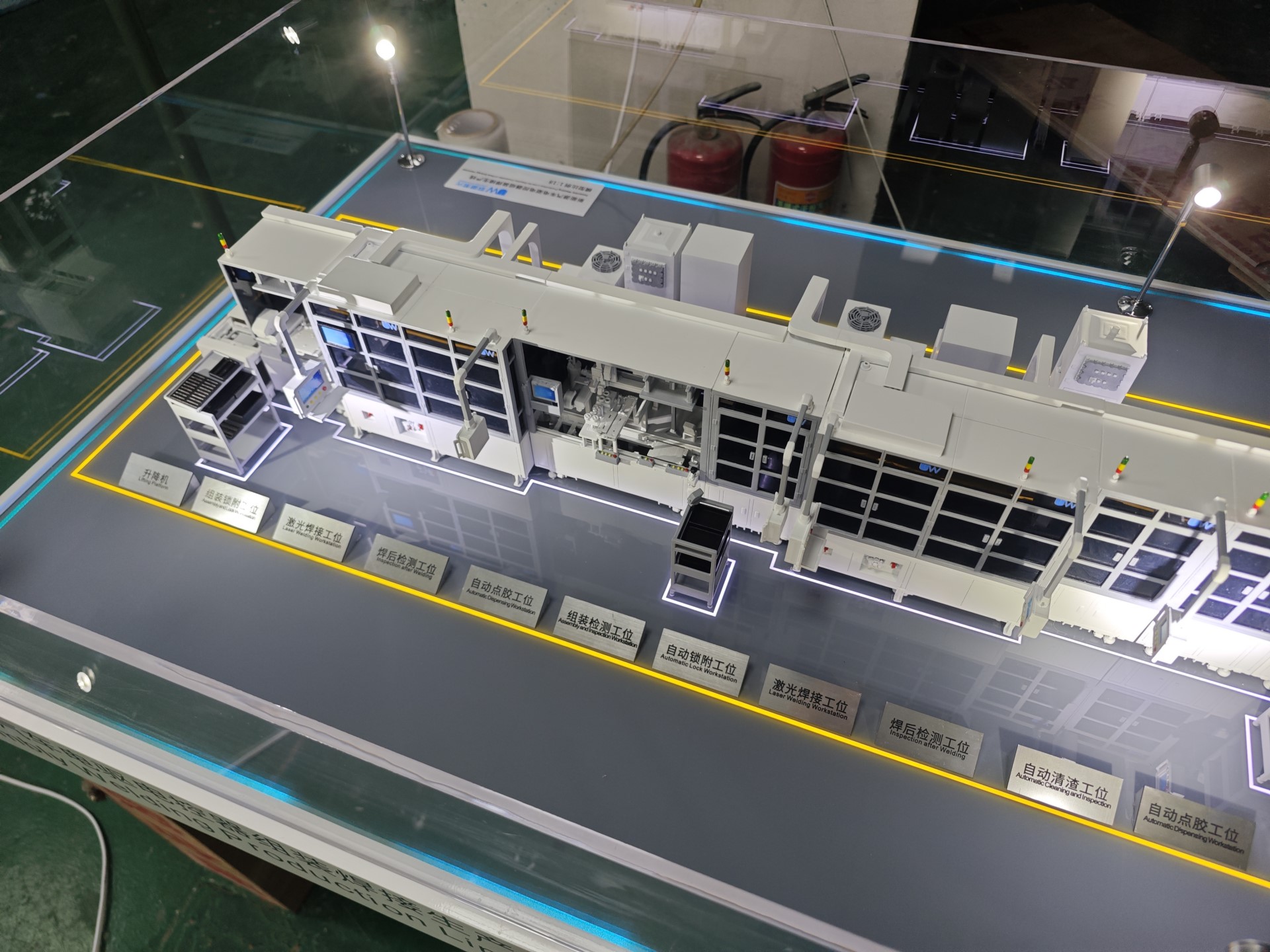
Understanding the concept of automated assembly lines is essential. Automation assembly lines are production lines that, in the course of production, complete the removal, processing, assembly and inspection of parts through automated equipment and systems and achieve efficient, accurate and low-cost production. Such production lines are often highly flexible and scalable, allowing for rapid adjustment and optimization to the production needs of different products.
We need to be clear about the purpose of customizing the automated assembly line plate model. These include, inter alia:
Showcasing the production process: Sand Table models can provide visitors with an intuitive understanding of the workflow of the production line, including the interface between the various processes and the material flow path.
Education and training: For operators, sandpad models can be used as training tools to help them familiarize themselves with operational processes and attention.
Problem diagnosis and improvement: By observing the actual operation of the sandpad model, enterprises can identify problems and make targeted improvements.
Cost control: Sand Table models can help enterprises to assess the costs of actual production, leading to more rational production plans and budgets.
Market analysis: Sand Table models can also be used for market analysis to help enterprises understand the production status of competitors and inform product positioning and market strategies.
The following aspects need to be taken into account when customizing the model of an automated assembly line sandpad:
Size-to-proportion: Ensure that the ratio of the sand table model matches the actual production line so that visitors can understand the production process accurately.
Detailed treatment: The sandpad model needs to reflect the details of the actual production line, including information on the type, quantity, location of the equipment.
Dynamic presentation: If possible, consideration could be given to the inclusion of dynamic presentation functions, such as simulation of the speed of operation of production lines, collaboration between processes, etc.
Interactivity: In order to increase the participation of visitors, interactive elements such as buttons, touch screens, etc., could be added to the sand table model to allow visitors to operate the production line directly.
Upgrading and maintenance: In view of possible changes in production lines, the sandpad model needs to have some capacity to update and maintain to adapt to future changes.
Let us talk about how to achieve those goals. First, enterprises need to identify their needs and budgets in cooperation with professional sandpad modelling companies. The production team will then design the required plate model based on factors such as the enterprise ' s production process, equipment characteristics, etc. There is a need to maintain close communication during the production process to ensure the accuracy and usefulness of the model.
Customizing the automated assembly line sandpad model is a comprehensive exercise that requires enterprises to work closely with the production team to develop both practical and attractive models. Through such models, enterprises are not only better able to demonstrate the production process, but also to identify problems, optimize processes and thus improve overall productivity and competitiveness.