Subway modelling
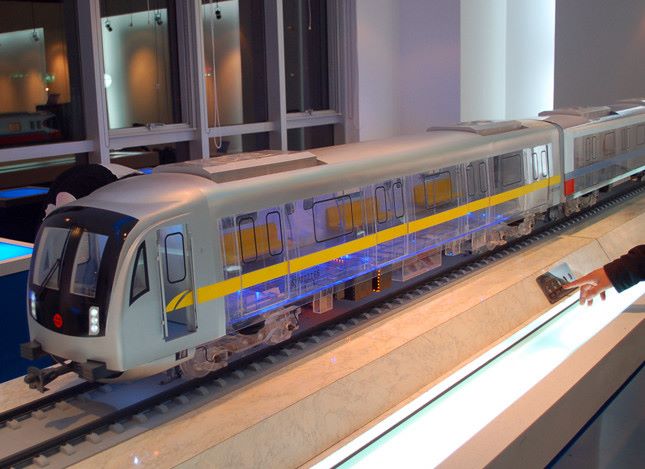
The metro model is based on a prototype of a genuine metro system, with full coverage of subway trains, metro stations, orbital lines, signalling systems, power supply systems and ancillary facilities, following the principle of precision proportional scaling, together with the logic of metro operations, equipment structural characteristics and customer use needs (demonstration, training, planning, science, etc.), and through a series of specialized processes, such as prototype mapping, structural dismantling, equipment resets, site set-up, inter-movementing, detail optimization, etc., to produce a model that is highly consistent with the real metro system。It focuses on “system integrity, equipment specialization, physical authenticity”, both in terms of the physical appearance, internal layout, door structure of the train in situ, and in terms of the complete recapitulation of the accompanying scenes, such as subway stations, tracks, screen doors, signs, etc., which can be driven, closed, light-linked, etc., according to demand, taking into account demonstration, physical and generality, and in order to fit the core needs of clients, such as the company operating the train, the Orbital Traffic Design Institute, the science institutions, the university and the exhibition halls.。As a professional process, it is widely applied in such settings as subway operations displays, staff skills training, orbital traffic planning seminars, science outreach, exhibition hall displays, industry fairs, etc. The production process covers matching of needs, metro site mapping, scale determination, material selection, train carving, station-building, orbital preparation, connection system installation, fine detail, modification of test acceptance, acceptance delivery, etc., which requires a sophisticated modelling process as well as an accurate understanding of the structure, operation logic, equipment principles of the metro system and a perfect integration of process, industry professionalism, practicality and presentation.。
Relevant questions and answers
The key to metro modelling is to balance the “system reduction accuracy, interconnectivity fluidity” with “situation suitability”, where users in practice often question the core points of system reduction, interconnectivity effects, durability, etc. The following are detailed answers to the two most core and concise questions that help clients to avoid risk and match needs.
Question one: how do we ensure that the model is accurately reduced by the detail of the equipment and the logic of the system, while allowing for a dynamic flow flow, by the complexity of the subway system, which covers various parts of the train, platform, orbit and signal?
Answer: The core is "System dismantling + precision mapping + alignment" and "coherent reduction and correlation"。First, deep dismantling of the metro system, docking with metro operations, design teams, clear parameters for the train, station layout, orbital specifications, signal system logic and interface of equipment, combing the whole process of metro operation and ensuring direction to fit the real metro system。Second, precision mapping to build the foundations, collecting the design drawings of the subway train, station layout documents, equipment parameters manuals, arranging for specialized mapping teams to go deep into the subway station, vehicle segment sites, accurate recording of core details such as the size of the train, platform structure, orbital spacing, barrier door specifications, ensuring full accuracy of the data, and eliminating the distortion of equipment ratios and layouts。Finally, recapturing and linkage, using 3D printing + manual finely combined, to refine core equipment details such as trains, shield doors, signal lights, etc.;Construction of an exclusive connection system that simulates the dynamic effects of train traffic, door switches, platform light switching, multiple rotations to optimize the connection logic and ensure that the equipment is connected in a smooth and natural way, both in terms of the overall surface of the metro system and visualizing the dynamics of subway operations。
Question two: how can I ensure that metro models, which often require long-term demonstration and frequent demonstration of their impact, are used in high-frequency (HF) use scenarios such as public science, staff training and so forth, while reducing later maintenance costs?
Answer: Focus on “Professional Selection + Process Optimization + Perfected Sales”, balancing durability, linkage stability and maintenance of ease。First of all, the selections are based on the need for a subway scene, with the main train, the platform frame, and the high-intensity industrial-grade ABS hard plastics, glass steel, etc., resistant to wear and tear, solid, non-conformable, suitable for long-term positioning and frequent touch.;Convergence parts, signal systems select precision grinding fittings to reduce operational wear and tear and ensure linkage stability;On the surface is an industrial spray process that restores the true appearance and quality of the train, station, and is not susceptible to fade, scratch, rust。Second, process optimization to enhance solidity, with a seamless collage + multiple fixed processes for train assembly, platform set-up to avoid long-term relaxation and loss of use;Refurbishable entanglements, line interfaces, optimize structural design and extend useful life;Quantified debugging of the interconnectivity system to reduce the incidence of cartons, malfunctions and adapt to high frequency subdemonstration requirements。Finally, better sold and lower costs, with operational and maintenance training at delivery, commonly available spare parts;Establishment of a 24-hour after-sale response mechanism for fast remote or door-to-door processing of loose parts, connected cartons, loss of components, etc.;Provision of long-term technical support to respond to needs such as model upgrades and linkage optimization, without the need for overall back-to-back work, significantly reducing later maintenance costs。
Core benefits of metro modelling
For the clients concerned, such as metro operators, orbital transport design institutes and science institutes, professional metro modelling not only helps to create simulations and support tools that match their needs, but also helps to optimize operational training, improve planning efficiency and enhance the dissemination of science to provide practical support for the development of the orbital transport industry, with the following benefits:
First, it provides a visual overview of the subway system and facilitates efficient communication and presentation. The size and complexity of the metro system makes it difficult for traditional drawings and videos to clearly present equipment layouts and operating logic. The model allows for the accurate return of system-wide scenarios such as subway trains, stations, orbital tracks, which are dynamically linked, allowing rapid audience attention and visual visibility of subway operations and design levels in exhibition halls and industry fairs, and provides a clear demonstration of subway system layouts, operating processes, streamlining communication processes and improving the success rate of negotiation and approval in planning reports and client negotiations.
Second, support staff training to reduce training costs and safety risks. The training of traditional subway workers relies on physical exercise, which not only affects normal operating order, but also has security risks such as station operations and equipment operations, which make it difficult for new staff to quickly master operating processes and equipment practices. The metro model, which replaces a real subway scene, is used for pre-service training for new employees, upgrading of the skills of older employees, visual demonstration of train operations, station service, emergency disposal processes, close observation by staff, simulation operations, shorter training cycles, circumvention of security risks from on-site training, while reducing physical equipment losses and significantly reducing training costs.
Third, assistive orbital traffic planning to reduce planning error costs. When the orbital transport design facility, the relevant functional units carry out metro route planning, site retrofitting and equipment upgrades, the planning programme can be presented in visual form through modeling, the pre-screening of problems such as unreasonable layout of the route, imperfect design of the site and poor equipment interface, the need for physical retrofit tests, a substantial reduction in the planning cycle, a reduction in the planning error costs and later overhaul costs, and an increase in the scientific and operational viability of the planning programme.
(d) Fourth, to strengthen the promotion of science and technology, and to contribute to the promotion and branding of industries. The metro model can transform abstract orbital traffic knowledge, metro operating principles into visual, comprehensible stereos, fit-for-scene sites, campuses, etc., and help the public to quickly understand the metro system, learn about orbital traffic, and contribute to the expansion of the orbital transport industry. At the same time, the high-quality subway model is an intuitive expression of the professional strength and rigour of the enterprise. It enhances client brand recognition and industry credibility and helps consolidate market positions and expand resources.