Model producers of new energy charging stations and compacting of compact disc models
Model producers of new energy charging stations and compacting of compact disc models
Introduction to conceptual breakdown
Against the backdrop of the era of “carbon peaks, carbon neutrality”, the new energy industry is reshaping our energy landscape at an unprecedented rate. As an important demonstration and teaching tool in this transformation, the “new energy recharger model producers” were created. Such plants focus on transforming complex photo-filled integrated systems, micro-grid technology and charging facilities into high-precision, interactive physical models. The "PV model customization" is its core business, not just a microcosm of physical form, but also a dynamic replica of energy flow logic.
The PCD model, which brings together four core modules for photovoltaic power generation, energy storage batteries, charge-posts and energy management systems, builds a micro-smart grid ecosystem. The manufacturer proportionally reduced key components such as container-based energy storage equipment, roof PVs, smart chargers, and simulated current flow, energy storage and release using acoustic PV technology. Such customized models, capable of matching accurately the needs of different clients for the appearance of specific brand equipment, specific terrain layouts or specific teaching scenes, are a bridge between abstract energy theory and visual engineering practices.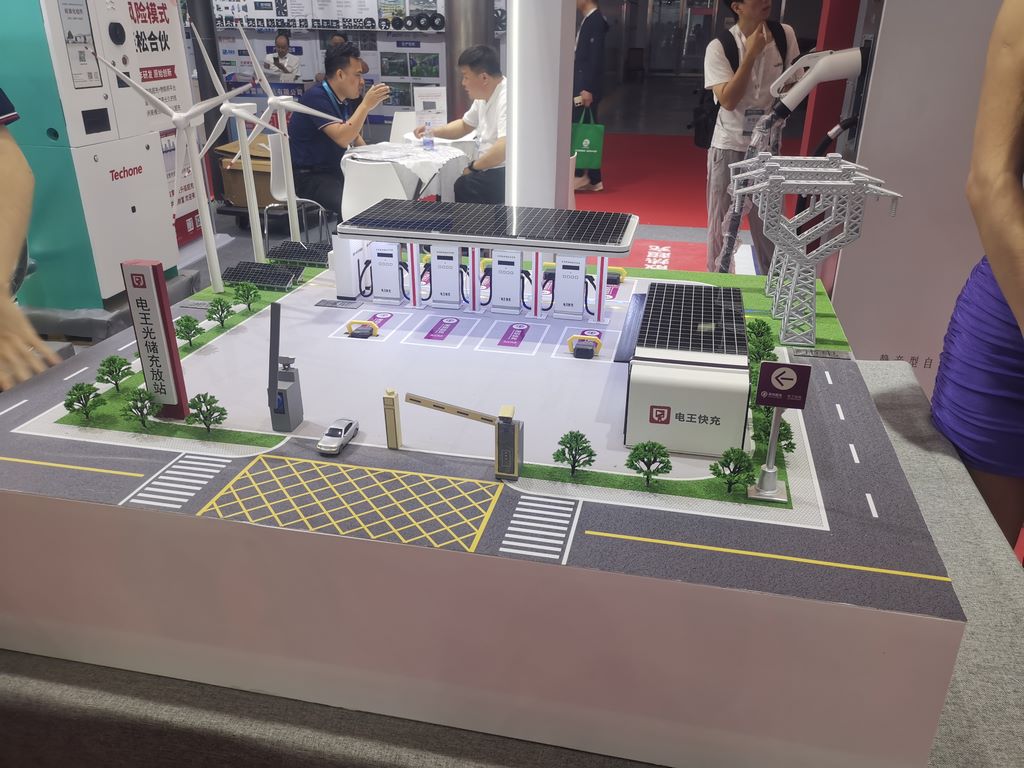
Related questions and answers
Question: How do you ensure that, when customizing a compact disk model, the model is consistent with the operating logic of a real power station?
Response: Ensuring consistency in business logic is key to measuring the professionalism of the plant. First, the manufacturer needs to have a deep electrical engineering background that can understand and convert real power station drawings and CAD models. Second, models usually use modular design, with built-in smart control systems, and are programmed to simulate real energy management strategies, such as " Peak Peaking Valley" or "PV priority". Prior to production, the client should require the manufacturer to provide a detailed control logic programme and conduct 72-hour joint testing at the acceptance stage to ensure that dynamic demonstrations of power generation, storage and use are in line with actual performance.
Question: Which scenarios do these models apply primarily and are they suitable for viewing by non-professionals?
Response: The application of the photolithography model is extensive. In higher education and vocational colleges, it is a practical tool for teaching new energy specializations; in business fairs and industry fairs, it is a window of technical strength and solutions; and in government planning departments it is a supporting tool for project feasibility. In order to adapt to non-professionals, manufacturers usually design touch screen middle-control systems, with visual LED light flow demonstrations, to transform complex electrical energy flows into popular visual languages that enable viewers to understand the cycle of energy without having to have expertise.
It's a good thing.
Customization of new energy charging station models has significant advantages. First, it has a strong visual capability to visualize invisible currents and abstract electrical conversion processes, helping viewers to understand at short notice the mechanisms for co-operating photo-filling systems. Second, it has a high teaching and practical value, and students or transport personnel can use operational models to simulate a system response under different conditions so as to acquire skills in failure screening and transport without risking on real high-pressure equipment. Finally, for enterprises, a fine and well-functioning sand table model is a symbol of brand-based technological power that can effectively enhance their image and competitiveness in the green energy sector.
Description of the detailed steps
Needs analysis and data integrationIn-depth communication with clients to determine whether the model is used for teaching, demonstration or scientific validation. Collection of data on station plans, equipment parameters and energy management logic.Programme design and ratio determination: The scale is determined according to the size of the display space, usually at 1:50 or 1:100. Designers produce 3D impact maps and layout maps to determine the location of photovoltaic arrays, storage containers and chargers.Core Part Production• Production of high-precision equipment casings, such as reversers, distribution cabinets, etc., using 3D printing techniques; production of photovoltaic panels to simulate power generation dynamics using Yakli and LED lamps; and use of ABS resin to make robust layers of equipment.Smart Interactive System IntegrationInstallation of microcontrollers and drive circuits and preparation of programs to achieve light logic. For example, when the simulated daylights are strong, the blue LED light is lighted along the path of the light to the load; when the battery is discharged, the orange light is switched to.Surface treatment and landscape beautification: Car-class paint spraying of models to ensure a sense of quality. Add environmental details, such as micro-greening, road markings, and create real charger scenes.Coordinated testing and delivery: Conduct long-term stability tests to ensure that all electronic components work normally, without short circuits or poor exposure. Finally, professional packing was carried to the site for commissioning.
Results of practice
Some college smart grid lab projectTo complement the reform of the new energy curriculum, a polytechnic university has customised an integrated disk of optical storage teaching. The model not only restores the power station layout, but also opens some control interfaces to allow students to write programs to change their energy scheduling strategies. Following its introduction, students have achieved a significant improvement in their practical skills, and the laboratory has become a new provincial energy talent development base.
An energy company is recruiting to show the sandpad.In preparation for a large exhibition, a storage energy technology company customised a sandpad model with AR enhancing real-life functions. Audiences can see structural profiles and real-time data flows within the device through a tablet computer scanning model. This exhibit, which integrates physical models and digital information, attracts a large number of potential investors and has generated a number of cooperative intentions on the ground, which have contributed significantly to the market expansion of enterprises.