Henghui Models specializes in digital model manufacturing. We customize all kinds of miniature models with advanced production techniques tailored to your project.

Service Hotline
18664173363
Industrial sewage treatment sand table model customization: full process resolution from concept to practice
2026-01-22 10:28
6
Industrial sewage treatment sand table model customization: full process resolution from concept to practice
Part I: Conceptual breakdown and introduction
The Industrial Sewage Treatment Sand Table Modeling is a comprehensive concept that integrates environmental engineering, model design and visualization teaching/dissemination techniques. We can read it into three core keywords:
1.
Industrial sewage treatmentWastewater containing pollutants such as heavy metals, organic matter, acid alkaline substances and suspensions generated during industrial production is treated with physical, chemical and biological purification to meet emission or reuse requirements. Common treatment processes include glazing sands, regulation of homogeneity, biochemical reactions (e.g. A2/O, SBR), sedimentation, filtering, disinfection, etc.
2.
Sand Table ModelsOriginal refers to a micro-entity model used in military or urban planning to display the topography and architectural layout of a stereo. In modern educational, scientific and engineering demonstrations, the sandpad model has evolved into a multifunctional presentation system with a high degree of visuality and interaction, with a dynamic demonstration, light simulation, and process visualization.
3.
CustomEmphasis is placed on `need-to-need design', i.e. tailor-made sand table models tailored to the specific needs of customers (e.g., industry-specific wastewater types, treatment scales, process processes, displays, etc.). Unlike standardized products, customized models are able to fine-tune the layout, flow course, equipment configuration of the actual sewage treatment plant and even integrate functions such as dynamic currents, LED instructions, automatic controls, etc.
In conclusion,Industrial sewage treatment sandpad model customisationThis refers to the design and production of a microdynamic model that visualizes the whole process of sewage treatment, process representativeness and visual performance, based on specific industrial sewage treatment projects or teaching needs, and is widely used in places such as tertiary teaching, environmental protection schools, business fairs, and engineering tender demonstrations.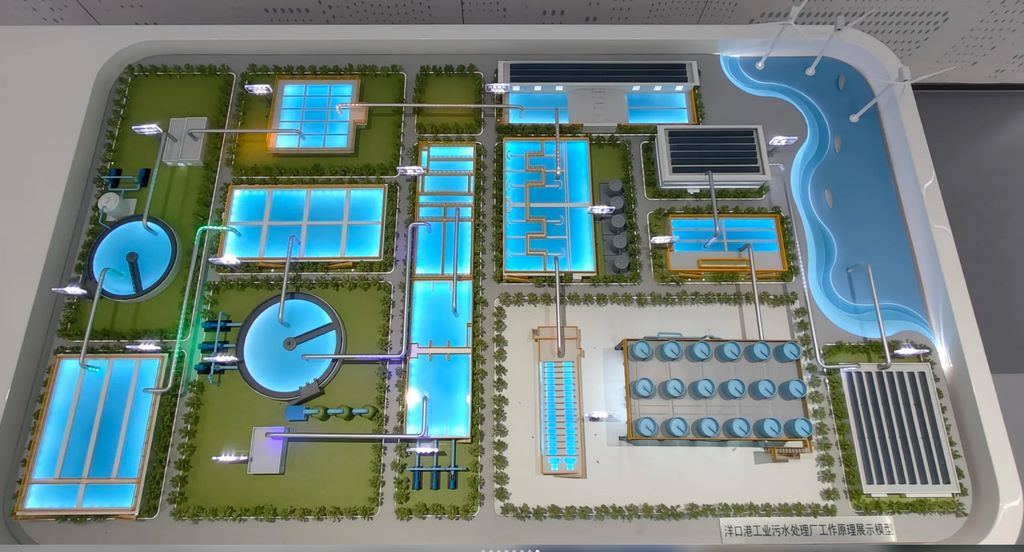
Part II: Common questions and answers
Question one: Does custom-made sandpad models really reflect real sewage treatment processes? Could it be just a "show"?
Answer:That's not true. High-quality customized sandpad models are more than just retrofitting; they focus more on “functional simulation” and “logical truth”. This is reflected in:
●
Real return of process: The model is organized strictly according to process processes of the actual sewage treatment plant, such as “pre-treatment-biochemical treatment-deep treatment-water discharge”.
●
Dynamic demonstration capabilityProcess visualization is achieved through mini-pumps, transparent pipelines, colour liquid simulation of sewage flow, with LED light belts indicating different stages of treatment (e.g. green signal water compliance, red signal high pollution into water).
●
Scale key equipment, etc.: Core constructions such as exposure tanks, dim ponds, sludge reflow pumps are suitably fine-modelled, and some high-end models can also be linked to PLC control systems to achieve automatic operation demonstration.It is therefore not only a model of “understandable” but also a teaching and presentation tool of “learning well”.
Question two: Is the long and costly customization worth investing?
Answer:While the initial input of customized models is higher than that of generic teaching aids, their value is reflected in long-term utility benefits and multi-scenes matching:
●
High Fitness: Specific treatment process models can be tailored to the wastewater characteristics of different industries, such as plating, dyeing, pharmaceuticals, food processing, etc., and teaching or displaying is more targeted.
●
Long useful life: Designed for dust containment using durable materials such as Yakli, ABS engineering plastics and metal components for more than five years.
●
Multi scene reuseA set of models can be used in a number of contexts, such as teaching, customer visits, project reporting, science fairs, etc., and combined costs are much lower than multiple outsourcings.
●
Support upgrade extensionModularization Design allows the addition of new process modules (e.g. MBR membrane processing, advanced oxidation units) at a later stage to extend the life cycle.
Therefore, customizing the sandpad model is a worthwhile investment from the input output ratio.
Part III: Benefits of customizing industrial sewage treatment sandpad models
1.
Teaching visualization to improve learning efficiencyStudents can clearly understand the abstract concepts of “activated sludge” and “nitronitration against nitrification” through dynamic processes, which are particularly appropriate for teaching in vocational colleges and environmental engineering.
2.
Showing specialization and enhancing corporate imageIn environmental exhibition halls or project tenders, dynamic sandstorm models can visualize technological strength and technological sophistication and increase client trust and probability of winning.
3.
Generalization of science to promote public understandingThe environmental fair for the general public can use models to explain the sewage treatment process, break the “black box” impression and increase social awareness and support for environmental infrastructure.
4.
Design validation aids to optimize engineering programmesDuring the engineering design phase, the sandpad model could serve as a visualized validation tool for the initial programme, helping to identify issues such as unreasonable layouts and cross-processes and reducing the cost of later changes.
5.
Supporting digital integration towards the display of wisdomIntegrated touch screens, AR-enhanced reality, remote monitoring systems, associated demonstration of “models + data” towards intelligent environmental education and management.
Part IV: Detailed steps for customizing the industrial sewage treatment sandpad model
Step 1: Needs research and targeting
●
Clear use: teaching? Exhibition? tender? Cope?
●
The determination of the type of industry: such as chemical wastewater, imposted wastewater, electroplating wastewater, etc., determines the treatment process priorities.
●
Scales: usually 1:50 to 1:200, combined with space display and detail requirements.
●
Budget scope and timing of delivery confirmed.
Step 2: Process process design and drawing
●
Process flow charts (P&ID) based on actual sewage treatment processes or syllabuses.
●
Modelling: Determination of the location of the processing units, the direction of the pipeline and the differential height of the equipment.
●
3-D model maps are produced using CAD or 3D modelling software (e.g. SolidWorks, SketchUp) for customer confirmation.
Step three: material selection and modular production
●
Main structure: Accumulation and ABS plastics, aluminium alloy framework to ensure stability and transparency.
●
Water flow systems: mini-pumps, transparent hoses, tanks, simulation of sewage flow.
●
Dynamic components: Small power-driven slurry, exposure headlight simulation, sludge back-flow pipeline.
●
Electrical control systems: LED lamps, relay modules, time controllers, automatic demonstration.
Step 4: assembly and system debugging
●
Module assembly: Pre-treatment module, biochemical pool module, depth processing module, etc.
●
Connect to the hydropower system to test pump pressure, light logic, fluidity.
●
Simulates the running of the whole process, adjusts the speed of the flow, the time series of the light and ensures that the demonstration is smooth.
Step 5: Delivery and training
●
Packaging transport: use of shock-proof wooden boxes and stand-alone fixation of key components.
●
Field installation or remote guidance debugging.
●
Provide operational manuals and maintenance guides and train users.
Part V: Presentation of practice cases and results
Case I: A bid demonstration model for an environmental technology company
●
Background• Tender for the EPC project for a sewage treatment plant in an industrial park.
●
Custom content1:100, including A2/O biochemical pool + MBR membrane system + sludge dehydration, integrated touch screen speech system.
●
Outcome: Model dynamic demonstration process at the evaluation site, visual presentation of technical advantages, successful award, client evaluation of “technical clarity and high professionalism”.
Case II: Construction of an environmental engineering workshop at a higher education institution
●
Background• Need to update the teaching equipment for traditional plans.
●
Custom content1:80 %, full process of treatment of pharmaceutical wastewater, with emphasis on high concentration organic matter treatment units.
●
OutcomeThe participation of students in practical courses has increased by 40 per cent, feedback from teachers is “complex and visible”, and the level of educational assessment is 95 per cent.
Case III: Upgrading of the municipal environmental library exhibit
●
Background: The original exhibit was a static graphic display, with poor interaction.
●
Custom content1:150 scale, urban integrated sewage treatment plant model, supporting viewers to start “water treatment process” by pressing buttons.
●
OutcomeDaily audience time increased from three to eight minutes, with an interactive participation rate of more than 70 per cent for children, and received the title of the Municipal Council for Science and Technology, “Presistence in Science”.
Concluding remarksIndustrial sewage treatment sandpas are customised not only as a microcosm of technology, but also as a bridge between knowledge dissemination and engineering expression. Through scientific design, precision production and multi-scene applications, it is making the complex sewage treatment process “visible, understandable and remembered”. In the future, with the integration of digital twinning and intelligent interaction technologies, such models will evolve into a "smart sandpad" and become an indispensable core vehicle for environmental education and industry.
Nadimak:
sadržaj:
Kontrolni kod: 
Komentar
Service Hotline: 18664173363
E-mail: henghui3d@outlook.com
Company Address: Room 606, Xuda High-End Intelligent Manufacturing Industrial Park, Xiaweiyuan, Gushu Community, Xixiang Subdistrict, Bao'an District, Shenzhen
Factory Address: Building 4, No. 341 Xiangmang West Road, Qingxi Town, Dongguan
Company branch: Huizhou Chongqing
Scan to follow us on WeChat
Scan to follow our Official Account