Medical equipment sand table model customization: full process resolution from concept to practice
Medical equipment sand table model customization: full process resolution from concept to practice
Part I: Conceptual breakdown and introduction
“Designation of the medical equipment sandpad model” is a comprehensive concept that integrates medical scene simulation, 3D modelling techniques and customization design and can be broken down into the following core elements:
1.
Medical equipment(c) Medical equipment (e.g. CT, surgical robots), first aid equipment (defibrillators, respirators), nursing equipment (infusion pumps, custodians), etc., and infrastructure in the medical process (operatives, wards, first aid corridors, etc.).
2.
Sand Table Models:: Visualization and operational simulation of medical processes through microtemporal models that present a medical landscape combined with technologies such as lights, dynamic demonstrations, interactive devices, etc.
3.
Custom: based on client needs (e.g. hospital type, unit characteristics, teaching purposes, presentation themes, etc.), precise design of model structure, functionality, ratio and technical integration to ensure both authenticity and usefulness.
Consolidated definitions(a) The medical equipment sand table model is tailored to the specific needs of medical institutions, medical colleges or medical enterprises, and is designed to provide a dynamic physical model of the medical equipment layout, operating process and treatment process, for use in teaching, awareness-raising, process optimization, and for visual, interactive and professional purposes.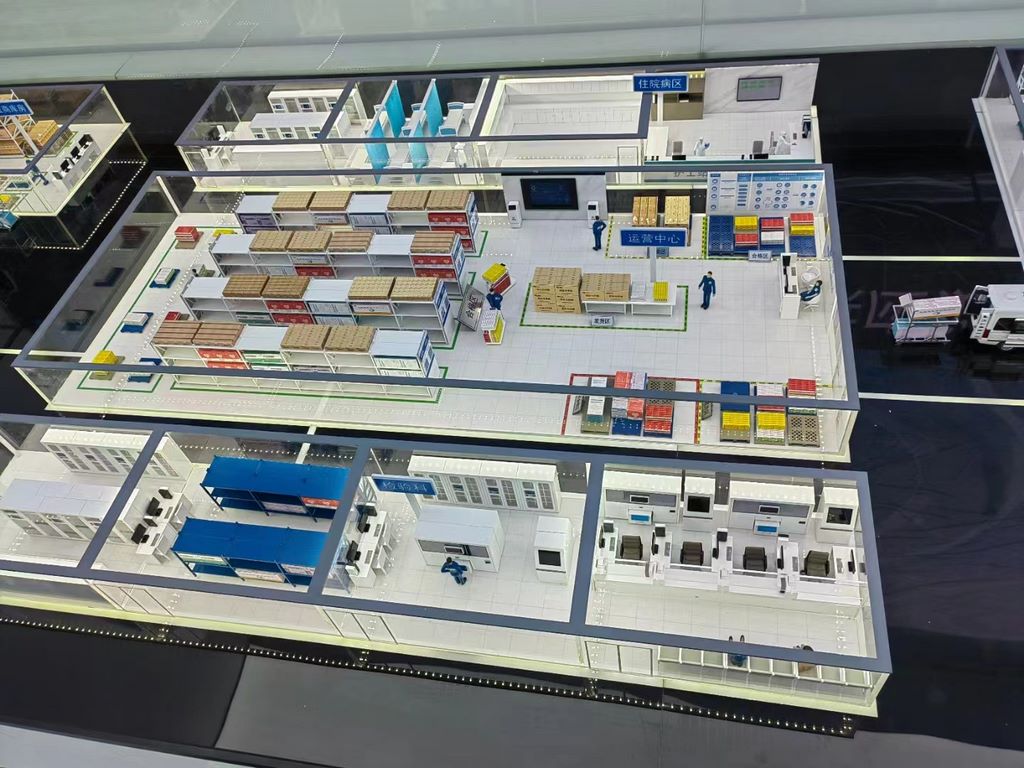
Part II: Common questions and answers
Question one: Can the sandpad model accurately reverse complex medical equipment operations and processes? Is it just a decorative display?Answer:
●
Operation SimulationHigh-end customized models can integrate micromechanical structures (e.g. revolving surgical arm, upliftable bed), and use processes are visualized by means of buttons or remote control simulation devices.
●
Process visualizationLED light marking equipment is used (green for normal operation, red for failure), dynamic water flow simulates the flow of fluids or blood and enhances the reality of the scene.
●
Data Connection: Some models support docking with real equipment data interfaces, real-time display of monitoring parameters, applicable to medical exercises and troubleshoot training. As a result, models are not only static demonstrations, but also tools with “operational, learning, analytical” features.
Question two: Is there value in the long and costly customization?Answer:
●
Teaching valueModels can replace expensive real equipment for medical hands-on training and reduce teaching costs while avoiding operational risks.
●
Long-term reuseModularized design allows replacement or extension of equipment modules (e.g. new AI diagnostic equipment) to extend the model ' s useful life.
●
Show the benefits.At hospital fairs or tender meetings, dynamic models can visualize technical strengths and enhance client trust and cooperation opportunities.
●
Return on investment• A single customization that meets multiple scene needs (teaching, advocacy, scientific research) with combined costs lower than duplicate procurement or ad hoc build-up. Thus, in terms of long-term benefits, customized models have high value for money.
Part III: Benefits of customizing the sand table model of medical equipment
1.
Improving the efficiency of medical education and training:: Simulation of first aid processes, surgical collaboration, equipment operation through modelling, allowing participants to practice repeatedly in a risk-free environment and to enhance their skills.
2.
Improved medical process optimization and decision-making: Managers can model emergency diversions, adapt equipment layouts, identify bottlenecks in advance and optimize resource allocation.
3.
Increased professionalism and appeal for outreachIn hospitals, medical equipment business fairs, dynamic models can visualize technological advantages and enhance brand image and customer experience.
4.
Supporting interdisciplinary collaboration and communicationModels as “common language” to help doctors, engineers, nurses, etc. quickly understand complex medical scenarios and promote teamwork.
5.
Supporting scientific research and technological innovation: Prototype testing for new equipment or processes to reduce R & D error costs and accelerate technology landing.
Part IV: Detailed steps to customize the sandpad model for medical equipment
Step 1: Needs analysis and targeting
●
Clear use: Teaching training? Hospital planning? Product presentation? Scientific simulation?
●
Identification of specific areas such as emergency care, operating theatre, ICU, rehabilitation centres, etc.
●
Data collection: Parameters of medical equipment, spatial layouts, operating process specifications.
●
Identification of technology needs: need for dynamic demonstration, interactive control, AR/VR integration, etc.
Step 2: Programme design
●
Proportional mapping: Modelling based on display space (e.g. 1:20 to 1:100).
●
Three-D Modelling: Designing equipment structures with CAD or 3D software, line direction, light layout.
●
Functional planning: Define dynamic components (e.g., mobile beds, rotary equipment), sensor position, control logic.
●
Client audit: Submission of impact maps and functional statements confirming details adjusted.
Step 3: Material selection and production
●
Main structure: use of medical-grade Yakli, ABS plastics, metal skeletons to ensure safety and stability.
●
Dynamic components: mini-engineers, gear transfer, hydraulic simulation devices (e.g. fluid pump actions).
●
Lights and circuits: LED lamps, programmable controllers (PLC), touch panels.
●
Details engraving: high-precision laser cutting equipment placards, pipe markings, restoration of actual equipment details.
Step four: assembly and debugging
●
Module assembly: Installed by section or process segment to ensure accuracy.
●
System integration: Connecting circuits, waterways, sensors to test connection functions.
●
Dynamic calibration: adjusts the size of the equipment ' s movements, light time series, aShare synchronization.
●
Fault simulation: verify the accuracy of the “failure-response-rehabilitation” process.
Step 5: Delivery and maintenance
●
Packaging transport: earthquakeproof sealing, independent protection of critical components.
●
On-site installation: Team door-to-door assembly, debugging to optimal state.
●
Operational training: guidance to clients on the use of control panels, maintenance of points.
●
Post-sale support: provision of spare parts, software upgrades and remote technical support.
Part V: Presentation of practice cases and results
Case I: Model for training in emergency care at a hospital
●
Custom contentThe 1:30 scale of the emergency section ' s pallet, which includes a clinic, rescue room, care room, an integrated analogue defibrillator, breathing machine operation.
●
Outcome• A 30 per cent reduction in training time for health-care workers, a 40 per cent reduction in the failure rate in the first aid process, and the award of the Provincial Medical Teaching Innovation Award.
Case II: Model presented at the Medical Devices Enterprise Fair
●
Background: Showcasing new smart surgery robots and equipment.
●
Custom contentThe 1:20 scale operating room model, where robotic arms can be remotely manipulated to demonstrate technical principles in conjunction with AR projection.
●
Outcome• A 25 per cent increase in client contracting and a 50 per cent increase in the efficiency of product interpretation as a demonstration of industry poles.
Case III: Virtual Simulation Laboratory, Medical School
●
Custom contentIntegrated medical scene sandpads, integrated VR glasses and modeling, simulation of disaster first aid scenarios.
●
OutcomeThe pass rate for students increased from 78 per cent to 92 per cent, which was classified by the Ministry of Education as a “Model project for education in smart medicine”.