Theme Garden Sand Table Modelling
I. CONCLUSION OF THE CONTEXT OF THE TYPE DRABS
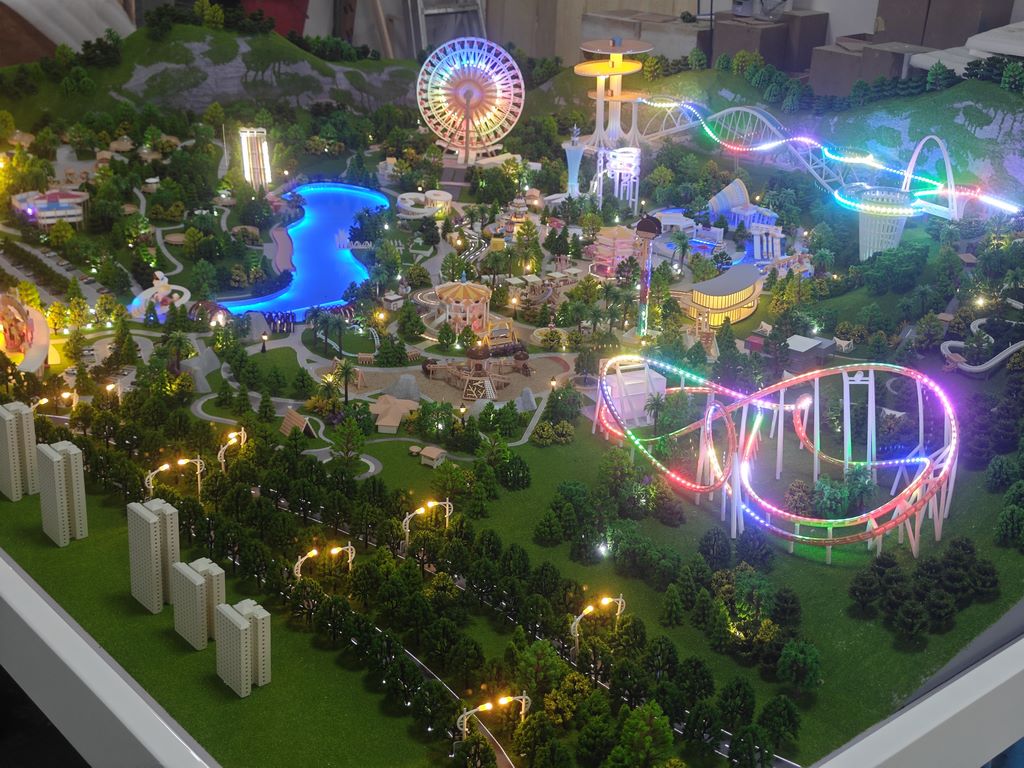
The theme park chassis model is based on a prototype of different styles of theme parks such as fairy tales, sci-fis, ancient winds, oceans, adventures, and the creation of a three-dimensional dish model with spatial authenticity, subject-temperature, functional experience through customization of modelling, landscape plasticization, landscape restoration, interactive integration, etc., in conjunction with the core needs of park planning design, commercial presentation, promotion, teaching of science, campaign planning, etc.。Its core value lies in the miniaturization of the complex space layout of the park, the visualization of the theme, the logical visualization of the operation, the focus on key elements such as recreational facilities, landscape nodes, commercial neighbourhoods, the supporting premises, the kinetic system, taking into account the specialization of spatial planning, the retrofitting of the theme, the accuracy of the landscape and the fun of interaction, which meet the diverse needs of the park ' s developers ' planning demonstration, the promotion of the civil sector, the teaching of the design of the institution, and the demonstration of the event at the site, as a reflection of the dedicated integration of the theme park design, the sand making process and the business of the tour.。
From core dimensions, the production process consists of three core modules: first, demand positioning and specification control, with the need to specify model uses (planning/presentation/teaching/activity), theme styles (sacular/sci-fiction/acoustics, etc.) and scale specifications (common 1:200 to 1:500, taking into account spatial presentation and detail reduction), core mass layouts, subject elements, facility patterns, landscape features, dynamic line design, and synchronized functional needs (e.g., light-linking, micro-orbiting, interactive touch, landscape switching);Second, the core elements are recapturing, which covers recreational facilities (trucks, carousel, skyboats, ghost houses, etc.), landscape nodes (green landscapes, waterfalls, fake mountain sculptures, light items), support systems (commercial blocks, restaurants, rest areas, bathrooms, parking lots), thematic elements of the atmosphere (totem markings, decorations, character models, special effects devices), which are at the heart of the chalk character of the theme park.;Three are process and material adaptation, including precision 3D modelling, laser cutting, 3D printing, hand-made plastics, landscape construction, light integration, interactive module debugging, etc., and material adaptation to thematic style and functional needs - - Construction components are made of ABS plastics, Akli, green plants are made of fungus, moss, micro-tree branches, water scenes are simulated with transparent resins, lights are integrated with LED lamps, mini-light bulbs, essentially through spatial restoration and thematic empowerment, to achieve a simulation of the integration of the theme park “Background-Function-Climate”。
Relevant questions and answers
Question one: How can the theme park sand table model be balanced against the thematic atmosphere reduction, space layout rationality and interactivity?
Answer: There is a need for synergy among the three, following the principle of “thematic climate is central, spatially based, interactive and enabling”。The theme atmosphere has been restored, with deep alignment with the core theme of the park, with precise recouping of dimensions from colour matching, material selection, decorative detail, light effect, etc., such as a fairy tale park with bright macaron colours, round building lines, cartoon decorations with warm yellow lights;Old Wind Gardens uses Deva white walls, wood components, kiosks, with warm orange lantern lights.;Science-fiction Gardens uses metallic sensory materials, geometry, fluorescent decorations with cool colour dynamic lights to ensure that the atmosphere fits the prototype height。Space layout with strict alignment of the park ' s general flat paper, precision restoration of the ratio relationship between the functional areas (goat, commercial, rest, logistics), the width of the movement, the distance of the facility, the landscape distribution, and control of errors of key parameters (e.g., the traverse rate of the roller coaster, the diameter of the wheel, the width of the block) within 5 per cent to avoid the distortion of the layout due to an enhanced atmosphere and to ensure that the chassis accurately conveys the logic of the park ' s operation and the efficiency of space utilization。Interactive function adaptivity, design according to use difference: planning sandpads weaken complex interactions, retain only basic light presentations and focus the layout;Demonstration/activity-type sandpad enhanced immersion interaction, such as adding functions such as micro-orbital vehicle operation, light zone control, touch talk, special effects spray, etc.;A modular interactive design of the school-class sandpad allows for the fragmentation of regional functions, taking into account practicality and experience Sensor.。
Question two: How do you fit different subject styles and use scene needs through material and process selection when making the theme park sand table model?
Answer: Dual matching through "Metal theme matching + process precision enabling" takes into account the quality of the atmosphere and practical value。Materials selected to fit different subject-style features: the building components of the fairy tale/paternity model are made of coloured ABS plastics, foams, rounded treatment of edges, green plants are imitated with soft moss, fury green plants, safety and child interests Sensor.;The architecture of the ancient wind park model is made of wooden sheeting, imitating brick stickers, imitating stone sheeting on the ground, using transparent resin with blue paint on the water scene, and restoring the ancient wind landscape. Sensor.;The architecture of the science-fiction park model is made of metal sheeting, Akli, with fluorescent stickers, reflecting material, reinforced by metal poles in orbital facilities, which highlights the sense of technology.;The surface of the ocean park model is based on blue gradients, the water landscape is based on bead resin, decorated with shells, coral imitation, and creating a sea climate. Round。With regard to the adaptation of scenes, the planning sandpads use durable materials (e.g. ABS plastics, wood floors) to enhance structural stability and allow repeated debugging;High-light material, special effects material (e.g. fluorescent material, spray device) for display/activity-type sandpads to enhance visual impact;Tutor-type sandpads with decomposable materials (button connection) with stickers to facilitate presentation。Process design, using style-differentiated processes: building components are reduced by laser cutting, 3D printing precision plastics, complex decorations (e.g., palaeon sculptor, sci-fi road) by manual carving, water-posting;Landscapes are constructed using hand-made plastics, stratification processes, green plants are grafted, and water is sprung through resins, texture treatment to simulate real form;The light and interaction module uses a finely integrated process, a hidden installation of LED lamps, precise embedding of interactive components (e.g., touch switches, microelectrics) to ensure that functions flow smoothly and do not disrupt the subject atmosphere, and that the full spectrum fits different themes and scene needs。
III. Advantages of making sand table models at thematic parks
1. Support park planning demonstration to reduce the risk of commissioning
The design of thematic parks involves complex dimensions such as functional zoning, animated layout, configuration of facilities, and landscape-building, and traditional drawing planning makes it difficult to predict intuitively the actual effects. Sand Table models can transform two-dimensional drawings into three-dimensional physical space, allowing planning teams, investors to view in a clear and intuitive manner the potential problems of regional proportions, facility spacing, fluidity of motion lines, landscape coordination, precision pre-judgmentation of motion lines, facilities conflicts, landscape masks, and inadequate commercial layouts. At the same time, planning risks and operating costs can be significantly reduced by re-engineered sandpads, optimizing the configuration of the facility, avoiding the waste of costs associated with later construction modifications, and providing a scientific basis for the landing of the park.
2. Enhanced presentation of vendors and promotion of the Civil Service to improve transformational efficiency
It is difficult to pass on the park ' s sense of space and its thematic charisma in words and pictures during its promotions. As a visual display vehicle, the sandpad model accurately reduces the park ' s thematic atmosphere, commercial layout, recreational facilities, landscape features, with light demonstrations, interactive functions, and allows investors, businesses and tourists to visualize the park ' s operational potential and experience. In the context of the outreach negotiations, core messages such as the location of the shop, the line of movement, the peripherals, etc. can be quickly communicated to the business community to improve the efficiency of the matchmaking process; in the context of the promotions and exhibitions of the brigade, the view of the audience can be drawn, the memory of the park brands strengthened, the promotion of the resources of the brigade and the attraction of visitors facilitated and the promotion of the transformational effects.
3. Enabling the design of teaching and campaign planning to enrich the application landscape
For specialized teachings such as design, landscaping, etc., the Sand Table Model is an important teaching tool for connecting theory and practice. It helps students visualize the spatial planning logic, landscape-building techniques, theme-breathing techniques, and enhances space design and hands-on capabilities through hands-on participation in modelling and adaptation. At the same time, the sand table model can be adapted to a variety of activities, such as pre-heat activities, parent-child interaction events, thematic exhibitions, which allow participants to experience the nature of the park through interactive sandpads, enrich the forms and content of the activities and increase the attractiveness and participation of the activities.
4. Optimizing operations and improving management efficiency
During the operational phase of the park, the sand table model can serve as an operational roller tool to simulate holiday passenger flow distribution, emergency evacuation routes, site layout, etc., and help the operational team optimize the passenger-flow orientation programme, adjust business patterns and plan emergency disposal processes. At the same time, it can serve as a training vehicle for staff, allowing new staff to quickly familiarize themselves with the regional layout, location and direction of the facilities, improving the efficiency and quality of training services and supporting the efficient operation of the park.
IV. A step-by-step process for the modelling of the Sand Table of Thematic Park
Step 1: Needs interface and data collection
Clear customization of core needs: identification with clients (the park developers, the civil service, colleges, campaign planners, etc.) of the thematic style of the model ' s suitability (the fairy tale/scisfiction/accultation/activity, etc.), uses (planning/demonstration/teaching/activity), scale specifications (commonly used: 1,300, 1.400), functional needs (light-linking/interactive touch/mini-orbit/special effect devices), appearance requirements (colour matching, detail reduction, atmosphere) and delivery cycle。Collection of core information, including park general drawings, functional partitioning, building plans, landscape design maps, thematic element reference maps, landscape impact maps, etc., combing of customized features (e.g., highlighting regions, thematic core elements, interactive functional priorities, safety requirements), development of detailed design programmes, lists of materials, process nodes, clarification of chain quality standards and subject presentation requirements, start-up with client confirmation。
Step 2: Precision modelling and programme optimization
Three-dimensional modelling based on needs and information, using modeling software such as CAD, SketchUp, for pre-set proportions of core elements such as park buildings, playgrounds, landscape nodes, kinetic systems, support facilities, etc., with precision in the size ratio, location, structure details of the elements and strict alignment with the prototype and theme style to ensure that the space layout is reasonable and subject elements are accurate。For interactive functions and light requirements, pre-set the built-in space for wiring, component installation, optimize model structure soundness and ease of assembly。Upon the completion of the modelling, generate partitioning of components, assembly diagrams, theme culture rendering, optimize communication with clients (including design team, operations team), focus on layout details, theme climate presentation, interactive functionality adaptation, confirm no objection and lock in the final model scheme and export production processing files。
Step 3: Core component production and plasticization
Production of core components by split programme, with priority for size accuracy, subject matter quality and structural stability。Construction and facilities component: building components are made of laser cutting ABS plastics, Aclik plates, complex configurations (e.g., antiquated windstands, sci-fi buildings) printed plastics through 3D, manual polishing, smoothing and thematic coating;Play facilities (terrestrial wheel, roller coaster, carousel) made of metal poles, ABS plastics, routing of light slots on the wheel, precise bending and reinforced on the proportion of the cruiser tracks, making of mini-seats and decoration details。Landscape component: green plantings are grafted proportionally by imitation of grass, moss, micro-tree branches, plastic green plantings, coated on fake mountains with hand-made plastics of foam, water stylished with transparent resins, simulated ripple effects combined with blue paint and texture treatment, sculptures, small objects etc. are made by 3D printing or hand-made carving, fit with theme style。Functional components: assembly of LED lamps, mini-electrics, touch switches, spray devices, etc., as required, testing light light brightness, orbital running fluidity, interactive responsiveness to ensure function stability;Simplification of interactive components for the planned sandpad, focus base presentation。Auxiliary component: production of wood display floors, glass shieldes, theme tags, with theme decorations, micro-persons models, preparation for subsequent fittings with beautification。
Step four: assembly integration and beauty debugging
Proceed in the order of " Basic Layout - Widget Emplacement - Landscape Building - Functional Integration - beautification "。Basic layout: Positioning of the functional areas by drawings first on the display floors, laying of ground-based materials (simulating plates, grasslands, roads), demarcation of the boundaries of the kinetic line and the landscape area, ensuring a precise layout。Component assembly: Installation of buildings, recreational facilities, support facilities, application of buttons, adhesion of adhesive glue, recalibration of position to ensure vertical construction, symmetry of facilities, movement flow Yes.;Installation of micro-person models, decorations, enhancement of scenery atmosphere Sensor.。Landscape development: layered landscape elements such as green planting, fake mountains, waterscapes, sculptures, optimization of landscape level and coordination, ensuring consistency of landscape and theme style;Paste theme tags, guide lines, improve presentation。Functional integration: placement of light lines, installation of interactive components, connection to power supply and control systems, debugging of light partitioning, micro-orbiting, tactile interpretation, special effects spray, etc., optimization of automatic demonstration program for demonstration type models, optimization of operability for teaching type models。beautification debugging: a comprehensive inspection of the integrity of the components ' connections, fine painting of buildings, facilities, grinding, correction of defects;Align lighting, colour matching, and strengthen the theme atmosphere;Test the flow of interactive functions to optimize the response speed of the component;Adapt glass shield installation to display scenes to ensure overall beauty and safety and to match actual usage requirements。
Step 5: Corporate acceptance and delivery
Receiving and inspection according to the " Layout Precision Test - Subject-Conception-Function Integrity Test - scene fit validation " process。Layout precision detection: detection of key parameters such as regional scale, facility location, kinetic width against prototype drawings, error control in standard range Internal;Subject culture acceptance: checking colour mix, material quality, decorative details, alignment of light effects with theme style to ensure that the atmosphere is back on track;Functional integrity testing: repeated debugging of lights, interactions, special effects, etc. to ensure smooth running, responsiveness, safety and stability;Scene adaptation validation: simulation of actual use scenario, testing of performance, interactive experience, portability, protective performance to ensure compliance with customer needs。After receiving and inspection, accompanying production of user manuals, maintenance guides (including cleaning, debugging, maintenance points), equipped with spare parts (e.g. LED lamps, mini-engineers, decorated stickers), delivered to clients as agreed, and provided necessary installation guidance, functional debugging and technical support。
V. CASES OF PRACTICE
Case one: Schift theme park plans a sand table model
A literary developer planned to land for the advancement of the science-fiction theme park project, customizing the 1:300 scale plan sand table model, with core requirements for a precise layout, a strong thematic atmosphere, and a supportive drive, adaptation planning demonstration and investment reporting。Prototyped with park planning drawings, the producers made future sensor buildings and play facilities using metal senses, ABS plastics, with fluorescent stickers and blue LED lamps, and restored the science-fiction atmosphere;Crosser orbits with precise bending of metal poles, reservation of light lines, use of grey gradient plates to simulate science-fiction landscapes on the ground, with mini-orbital vehicles and interactive touch panels to demonstrate the performance of passenger lines and facilities。The sandpad helped the planning team to accurately detect 2 kinetic cord congestion problems, 1 facility layout conflict, and an optimized programme resulted in a 12 per cent increase in the utilization of park space and an 18 per cent increase in the efficiency of traffic diversion。In investment reporting, the sand table visualization conveys the planning logic and theme charisma of the park, enabling projects to be quickly approved for investment and becoming a central support tool for planning landings。
Case II: The Pale wind theme park shows the sand table model
An ancient wind theme park launched a business outreach campaign to attend the cultural exposition, customizing the 1:400 scale to display a sandpad model with core needs to highlight commercial neighbourhoods and landscape features with a strong, interactive and easy to wear。The producers used wood sheeting, masonry stickers to make tablets, ancient street buildings with red lanterns LED belts and imitation green trees, stone bridge water viewings, and retrofitting the old style Land;• Production of microbusinesses and signboards in commercial neighbourhoods, with light-lighted shop lights, integrated tactile delivery modules, click on the corresponding area for voice presentations;Models are modularized and are assembled in 20 minutes, with the palaeon and glass shield。On-site exhibition, the sandpad attracted a large number of business and tourist attention, thanks to a fine, ancient atmosphere and interactive experience, with a cumulative number of 300 consultations with clients, 15 offers to assist the park, a 30 per cent increase in the rate of completion in commercial neighbourhoods and an effective transmission of the value and business potential of the Paradise Brigade。