
Fighter modeling case: full process from material selection to detail restoration
Preparation of materials: selection of materials, reduction of quality
We need to make a model for a fighter.LightQuantitative♪ And ♪Details. Core material selected as follows:
Main Frame: The selection of light wood (low density, ease of processing) to be used as a key bearing structure (e.g., wings, skeletal skeletons) with a plate (high strength, robustness) to ensure that the model is light and not deformed.
Outer Overwritezirconium: Polystyrene foams (which are strong in plasticity and are precise enough to fit the arctic surfaces) or EPP foams (which are strong against wrestling and suitable for later grinding).
Detailed accessories:
Engine entry, landing gear: selection of ABS plastic (good resilience, complex structure);
(a) Arms hangers, radar masks: use of resins (high fineness, small size details);
Aircraft number, badge: with an PVC plate (which is easy to cut and which can be reduced by later paper).
Production process: step-by-step construction of “bones and flesh”
The key to the model's 90% reduction lies in the luminum.Structure layers synchronize with detailsA three-step process propulsion:
Bones construction: pre-emptive “bones”
The skeletons of the body, wing and tail are proportionally cut with light wood and glued with white emulsion + 502 glue (coated with thin water to avoid deformation).
Wings and fuselage skeletons are fixed by “ded + glue” to ensure a strong structure (sliding with sandpaper in the dice to reduce later grinding resistance).
Outer cover: fit "skin"
The foam sheet is tailored to the surface of the fuselage and wing, and the skeletons are fitted with thermal smelting tape (the foam sheet is hot and deformed and needs to be pasted quickly to avoid overheated).
Focusing on ZenCurve Details: Like a cone in the front section of the fuselage, the radians of the wings are grinded repeatedly with sandpaper, the foam sheet is fully bound to the skeleton, and sandpaper is smoothed from thick to thin (80-ray 240-eye 400) to remove collage cracks.
Installation of accessories: implantation of “soul”
Engines enter gas lanes: Cylinders with ABS plastics, internal foam filling (simulation of a real airway structure) and stick to the position of the aircraft.
Arms hanger: Leather fittings are smoothed ahead of schedule, and 502 glues are attached to the wings, with attention to symmetry with the fuselage.
(b) Rise and faller: The resin slab is attached to the base of the fuselage, the tyre is used in silicone material (simulating the rubber sense) to enhance authenticity by connecting the stairs to the body.
III. Post-treatment: upper colour and detail "eye"
The top color is the core of the reduction.Layer processing + manual patches:
Bottom-colour spraying: `Bed colour'
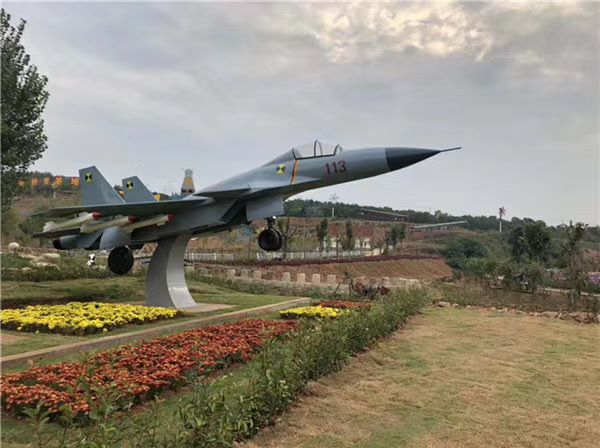
A black base paint (covering foam) is sprayed with the main tone (e.g., light grey body on the map) and each layer is sprayed with a low temperature drying (to avoid foam deformation) by a blower.
The main tone of the wing, tail, etc. areas needs to be even, and the edges are supported by protective tape to ensure that the colour blocks are clean.
Detailed hand painting: restoration of “soul”
Number and badge: Tired “113” with a propyl pigment (red font in the reference map, shadowing on the edge with a fine pen to enhance the stereo feeling); decorated with a sticker (pre-printed high-resolution pattern, fixed with nail polish).
Weapons and airways: Missiles use black + silver gradients (simulating metallic senses) and within the inlet wall deep gray + light gray gradients (simulating the level of real inlet).
Metal sense: Metal components such as landing gears, weapon hangers, coated with silver paints, then “oil stains” with diluted paints (e.g., brown), followed by light-cleaning of silver with a thin liner to simulate metal reflection.
Overall grinding: elimination of “close marks”
The entire machine is "whole grinding" with 400 sandpapers, with a focus on the collage of foams and accessories, so that the model surface is "integrated".
After grinding, the wind blower blows the dust, then wipes it with clean soft cloth to ensure that the surface is free of impurities.