
1: Military modeling factory, East China Military Modeling Customizing Plant
Case of modeling of military vehicles: complete process from skeleton to top colour
In the corner of the industrial plant, a model of a military vehicle is undergoing a transformation from drawings to finished products. This is a model.90% reductionZirconium is targeted, and the production process revolves around “bones-morning-up-colour-old” and materials are selected to balance the sense of quality with the details, while post-treatment gives the model a real battlefield sense of quality by colouring and obsolescence.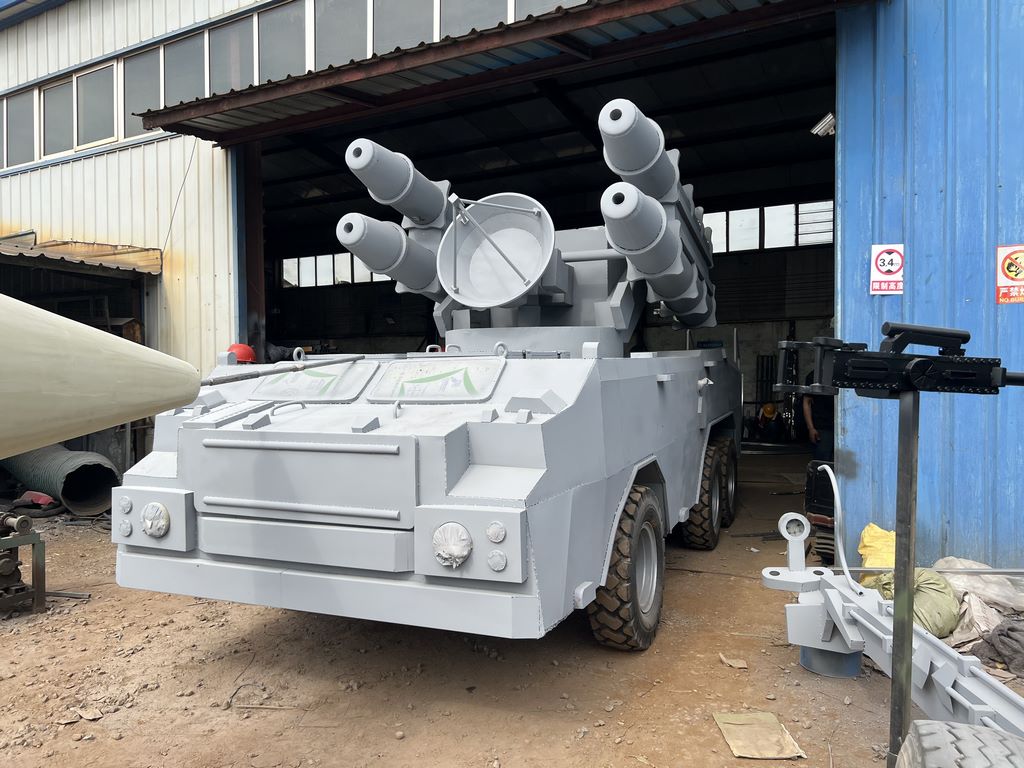
I. Bones build: drawings to metal “bones”
At the beginning of the production, the team designed the skeletons based on the military vehicle prototype. The workers will be50 mm x 50 mm x 2.0 mm square steelIt is tailored to different lengths and is combined by welding into a model “bones”. The skeleton needs to be precise enough to match the size ratio of the prototype vehicle to ensure the accuracy of subsequent skin covering, detail installation - this is the “ground base” of the model reduction.
Skin and structure: “skin” for zinc plating
After the skeleton is finished, the worker chooses the twig.2mm thick zinc platingZip it in the mompi. The thickness and hardness of the plate plating support the overall structure of the model while at the same time simulating the metallic sense of a prototype armoured vehicle. ♪ When you're in Montpellier ♪RelayThe platinum is connected to the plate plate and the skeleton to ensure both the structural strength and the logic of the armoring of the prototype vehicle by nailing the details.
Twist and base paint: “Breath” on the surface
After the skin, the surface of the model needs to be painted.Professional geisha., repeatedly covered to fill the gap and flatten the surface. After the natural wind drying of the grubs, the workers rubbing and grinding fibre materials at the seams, then treating the grub layer with a grinding machine to make the surface smooth. This step is the basis for the subsequent colouring - the flat surface ensures that the paints are evenly attached and avoids defects such as the “leaving paint” of the orange skin.
Top colour: the “soul” of the reduction level
The upper part is the key to the model being “live”. The team's gonna spray the model first.Water and soilZirconium (like underpaint) to give the model a uniform base colour. Subsequently, according to the style of the paint of the prototype vehicle (e.g., colour of colour, military colour), the selection of the chalkWater model paint♪ Or ♪Oily model paints。
Hand-painted.: Using the technique of “crossing” - one horizontally, one vertically, and several times evenling the coloured texture; the second and third layers of the colours are hand-painted with a “wire-shaped” hand-painting, sculpting the contours through a face-to-face pen, colouring with a flat pen to allow the colours to transition naturally.
Sprayed colourzirconium: Cover non-coloured areas with a mask belt (or plastic rubber) and control the air pressure and distance (15-20 cm) when spray pumps are sprayed to ensure that paints are evenly mistified and to avoid “maxes”.
The ratio of diluents to paints needs to be adjusted flexibly: water paint hands dilution ratio 1:1, spray 1:5, oil paints 1:2, spray 1:6. After dilution, the fluid flow speed of paints is tested with a stick - a requirement for thinness suitable for spraying pen fogging is indicated when the flow is consistently even.
V. OLD FORMING: ENHANCING “BALL FORMEMBER”
To make the model more real, the team goes through the box.Oil stains, wear, rustOld-fashioned techniques, i.e. simulation of the use of prototype vehicles:
Oil stains: Oil paints are prepared with oil colours (deep brown, light yellow, orange mix), thinners are added to make the paints translucent, then “streaming” effects are done on vertical surfaces (e.g. engine compartments), horizontal surfaces (e.g., top of a car) are painted with paper towels to draw the back point of the brush, to simulate the natural perception of fuel spills.
wear: In areas prone to wear and tear, such as wheels, belts, light grinding of the paint layer with fine sandpaper, displaying of base paints, local colouring, and simulation of long-run wear and tear.
Rust: In metal stitches, on the edges of the armour, the stain paint spot is painted, the diluent is dizzled and the metal oxidation is reduced.
End of detail: let the model "breath"
In the end, team against team.Lights, antennas, cannonsSmall parts such as thorium are finely processed:
Car lamps: Simulate glass senses with transparent resins, fill the interior with micro-LED lamps (or mimic reflections of duds paints) and allow the light to "light";
(a) Antennas: the shape of the prototype antennas in the form of metallic silks, the oxidation of surfaces and the restoration of a sense of weather in the battlefield;
Artillery tubes: Sprayed with dummies, then “stained” with finely painted pen dots, simulated after the barrel was fired.