
Industrial Facility Model Manufacturing Plant, New Energy Equipment Sand Table Model Customizer
Project background
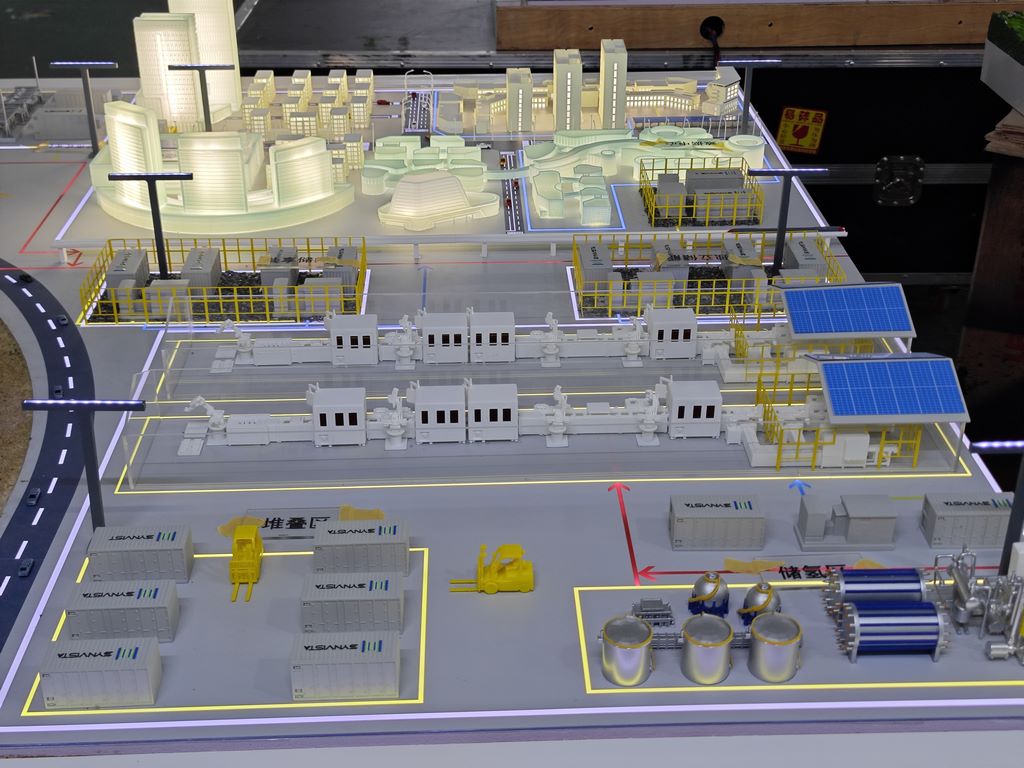
I was commissioned by an energy group to take over the production of its "Green Hydrogen Demonstration Base" promotional model. The model needs to be restored to the core facility of the plant at a scale of 1:50, with a focus on solar hydrogen production and an overall reduction requirement of 90 per cent.
Core production process
1. Bone construction phase
The use of laser cutting of the Aklik plate as the base of the building to ensure that the site reaches the sharpness of industrial building standards through seamless binding of acetone solvents
Pipeline systems use copper core wire to outsource PVC hoses, spray metal base paints after bending down, and simulate the softness of real pipes and interface French structures
2. Feature component production
Optical Matrix: Print solar panel threads with transparent PET film UVs on the back to enhance the aluminum reaction and adjust each plate by an angle of 5°-15°
Cell3D-printed resins are manually polished and coated with car repair paints to reflect temperature changes in titanium alloy equipment
3. Environmental construction
The topography uses high-density foam sculpture, surface-covered plaster mixture to shape the tortoise cracks, dry-cleaning mineral paints to simulate salin gland.
The character scene was selected with a HO-scale railway model human puppet, customizing the reflector vest coat, hand-held tablets to perform digitally driven scenarios
Colour Management System
The main equipment area uses Cool Gray 7C as the standard colour and enhances the stereo by spraying prepainted shadows Sensor.
The hazard area is standard yellow-and-black stripes with an exact width of 0.3 mm.
The effect of the rust is a three-layer dye: first a brown-red varnish, then a local tan lacerator, and finally a dry-cleaning of the shallow orange edge.