
Modeller for internal aircraft structure demonstration, Space Shuttle model custom manufacturer
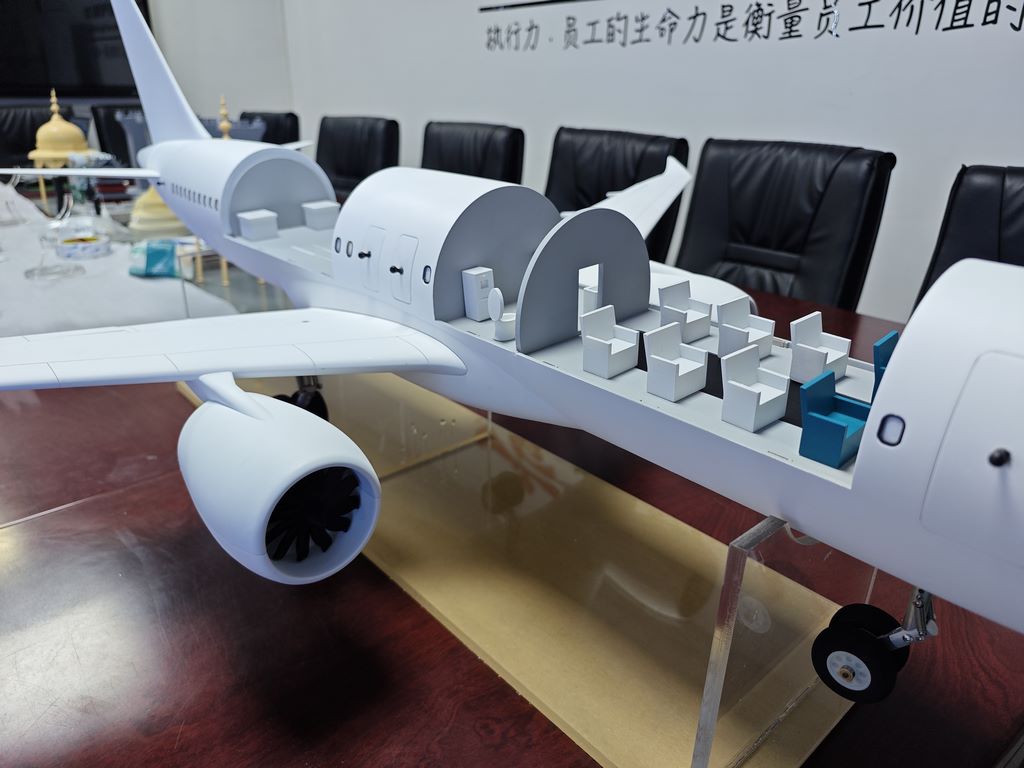
Case of modelling of internal structure of aircraft
Project requirements
Clients provide complete aircraft engineering drawings requiring a 1:50-scale internal structure demonstration model with a focus on core areas such as passenger seat layout, cockpit metering areas, cargo compartment partitioning. The model needs to have a demoliable hatch/cap function that allows for a multi-angle presentation of internal details, with an overall reduction of not less than 90 per cent.
Core processes and materials
Data pre-processing and component design
The client drawings were reconstructed three-dimensionally and the models were broken down into modules such as body casings, moving parts (barrel doors, landing gears) and transparency units (barrel windows) to ensure the accuracy of assembly.
Locally thickening of thin wall structures (e.g., wing front) to avoid printing deformations.
3D printout
Main StructureTechnical-grade photo-sensitized resin printing to ensure a smooth curve-free ladder, with 0.1 mm of mass differentials reserved for critical connections.
Transparent Component(c) High-perceived resin printing in cockpit windshields, passenger-barrel windows, and mist polishing later.
Fine PartMicrostructures such as seats, dashboards, etc. are printed with 0.05 mm thick surfaces directly up to class A light.
Reprocessing process
Support removal and repair: Removal of residual resins with ultrasound washing equipment, manual refinement of modulation lines and supporting point marks.
Moable Structure Debug: Seal doors, landing gears, etc., are embedded in microaxis to ensure that there is no glitch.
Colour preload detection: test assembly of unpainted group models to verify structural interference.
Painting and Mass Expressions
Bottom Paint Processing: Full grey base paint to fill micro-deficients, 400-coloured sandpapers partially flaring.
Colour Spray:
The main body colours are whited by duds, which are replaced by the masking process to restore the customised waist line coating.
The inside seats, dashboards, etc., are the details of the leather texture and metal buttons that are restored through the printing process.
Ageing and marking:
Light-drying at the edges of the hatch, the landing gear, etc., to simulate metallic wear marks.
The Division ' s LOGO, security marker, is adhesively located and partially modified with paint.